The alley
The Wind-Up Bird ChronicleThe alley is a dead-ended passage behind the houses in the neighborhood of Toru Okada and Kumiko Okada, at once a physical shortcut that no longer leads anywhere and the route Toru repeatedly takes toward the vacant Miyawaki house. Its fences, overgrowth, and unnerving silences place it between ordinary domestic space and the deep well where Toru’s memories and sense of reality begin to change.
Formation and Physical Character
The passage once connected two streets, according to the story Toru heard from his uncle, who rented him a house for a nominal sum. During the rapid housing growth of the mid-fifties, new homes crowded the route until it became little more than a narrow path. Residents disliked strangers passing close to their gardens: one end was screened by an unassertive fence, the other closed with a cinder-block wall, while a barbed-wire barrier blocked the remaining end. Since the neighbors did not use the route and welcomed the added protection, it was left to become an abandoned canal between two rows of houses, with spiders spreading webs in the overgrowth.
The alley is about two hundred yards long and barely more than three feet wide. Fences and objects jut into it in places, forcing a person to edge sideways between the walls. Its name is practical rather than exact: it has neither entrance nor exit, and even the description of it as a passage is unsettled by the fact that it takes no one through. The cinder-block wall becomes a point of access for Toru, who climbs over it to enter the neglected strip.
Route to the Vacant House
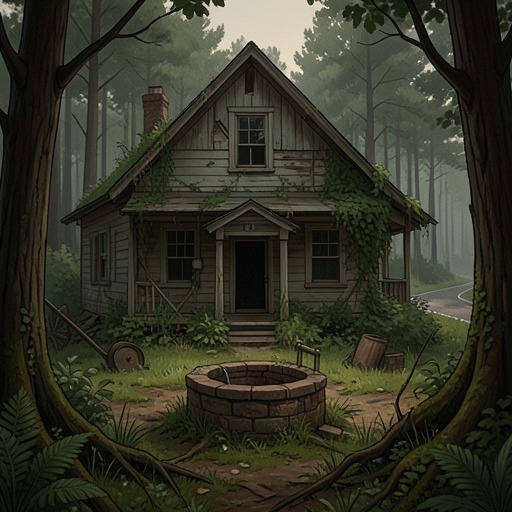
Toru goes into the alley while searching for the missing cat, following Kumiko’s instruction to look there despite having walked the route only a couple of times before. He wonders why Kumiko had frequented a place where spiders were common, but decides that looking is better than remaining indoors waiting for the telephone. The alley therefore joins the cat search to the vacant house Kumiko has mentioned: at its far end, beyond a garden with a large doghouse, Toru finds the empty Miyawaki house.
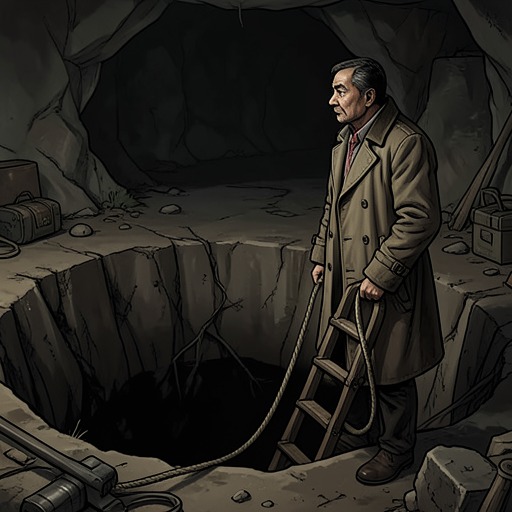
The house’s small garden preserves a striking contrast between apparent domestic shelter and abandonment. A chest-high stone bird statue stands amid tall weeds, with goldenrod nearly touching its feet; beside it, aging plastic lawn chairs lean against the house and an azalea bears bright-red blossoms. The bird’s open wings suggest escape, but the garden offers no way out of the alley’s enclosed, neglected world. Later, Toru passes through the same space to reach the well, removes the stones holding its cover, and tests the depth with a pebble before lowering a rope ladder tied to a nearby tree.
Silence and Changing Perception
The alley’s sensory character varies with Toru’s visits. In early-summer sunshine, branches cast hard shadows over the pavement, and the stillness is so complete that he imagines he can hear grass breathing. On a rainy, uniformly gray day, he hears neither birds nor street noise; the clouds seem to absorb not only sound but perception itself. As he moves past the eaves and squeezes between drying poles, even a radio talk show fades until its speakers seem to recede with the sound.
These repeated crossings make the alley more than a route between homes. Its narrowness slows movement, while its blocked ends and muffled sound unsettle the familiar neighborhood around it. When Toru returns after being down in the well, the surroundings feel unfamiliar to him, as though a new reality has displaced the old one during his absence. The alley registers that estrangement in a concrete place he has crossed many times.
The House, the Well, and What Remains
The Miyawaki house had once held a family whose cheerful life seemed, to a neighborhood child, almost impossibly happy. After the family disappeared, the building seemed to shed its connection to them and become an impassive vacant house. That change left a lasting impression on May Kasahara, who spent long stretches looking at it from her desk. The alley thus leads not only to an abandoned property but to a place where the difference between a house as a lived home and a house as an empty structure becomes difficult to ignore.
In winter, after the old house has been demolished, Toru returns along the alley and sees the lot behind a high plank fence. The bird sculpture, trees, paving stones, and well are gone; only compacted black earth and scattered weeds remain. The route persists, but its destination has been erased. Toru can scarcely believe that the deep well he descended into once lay within that cleared ground, making the alley a surviving approach to a vanished landscape and to experiences that the ordinary neighborhood can no longer visibly contain.